
A market signal isn't a prediction. It's a movement that stands out on several counts: size, speed, timing, agreement between bookmakers and consistency. It's usually the combination that catches the eye, not any single feature.
Not every movement is a signal
Thousands of odds move every day, for all sorts of reasons. Most of the changes are small, short-lived or invisible unless you're looking. So not every movement deserves the same attention, and that's where the idea of a signal comes in.
Every signal is a movement. Plenty of movements never become signals.
Understanding odds movements →
What is a market signal?
A market signal is a movement with enough notable features to justify a closer look.
It's a way of sorting movements, nothing more. It promises nothing about the result and it isn't a tip.
The 5 features of a signal
When a movement catches the eye, it's rarely because of one thing. Several factors usually work together:
- size
- speed
- timing
- agreement between bookmakers
- consistency
Size
Size is how far the price has moved. A tiny shift rarely gets much notice, while a big one does. The more pronounced the movement, the more it tends to be worth watching.
Speed
Speed is how quickly the movement happens. A slow drift over several days doesn't say the same thing as a large shift within minutes. The pace is part of the picture.
Timing
When a movement appears often matters as much as the movement itself. A shift several days before a match isn't read like one just before kickoff. Context counts.
Agreement between bookmakers
A steam move happens when several bookmakers move at the same time. That usually draws more attention. The market seems to be converging on one reading of the event, which people call alignment or consensus.
Consistency
A signal gets more interesting when several indicators tell the same story. Say several bookmakers move the same way, the shift is fast and the timing is unusual. Taken together, those three say more than any of them alone. I give that kind of agreement more weight than any single feature, because a big move at one bookmaker can be an outlier.
Not every signal has the same strength
Signals come in sizes. Some barely register. Others are hard to ignore. The gap usually comes from how many notable features show up together.
Few bookmakers involved, gradual variation.
Several bookmakers follow, interesting timing.
Large variation, market agreement, notable timing.
Why some signals draw more attention
A move seen at two bookmakers and one seen at twenty don't carry the same weight. The more notable criteria a movement combines, the more attention it gets from people who follow the market.
What to look at first
When a movement appears, these five checks come first:
- its size
- its speed
- how many bookmakers are involved
- the moment it appears
- whether the market as a whole is consistent
You're not hunting for certainty. You're deciding whether the movement deserves more of your time. That's a different question from expected value, which you'd still need to weigh before a stake means anything.
Examples of signals: football, tennis, basketball
These are made-up examples.
In football, a price that slips from 2.00 to 1.98 over several days, with few bookmakers following, is a weak signal. The movement exists, but it has almost none of the features of a strong one. A good chunk of the market looks exactly like this, and it's easy to forget that when you're hunting for something exciting.
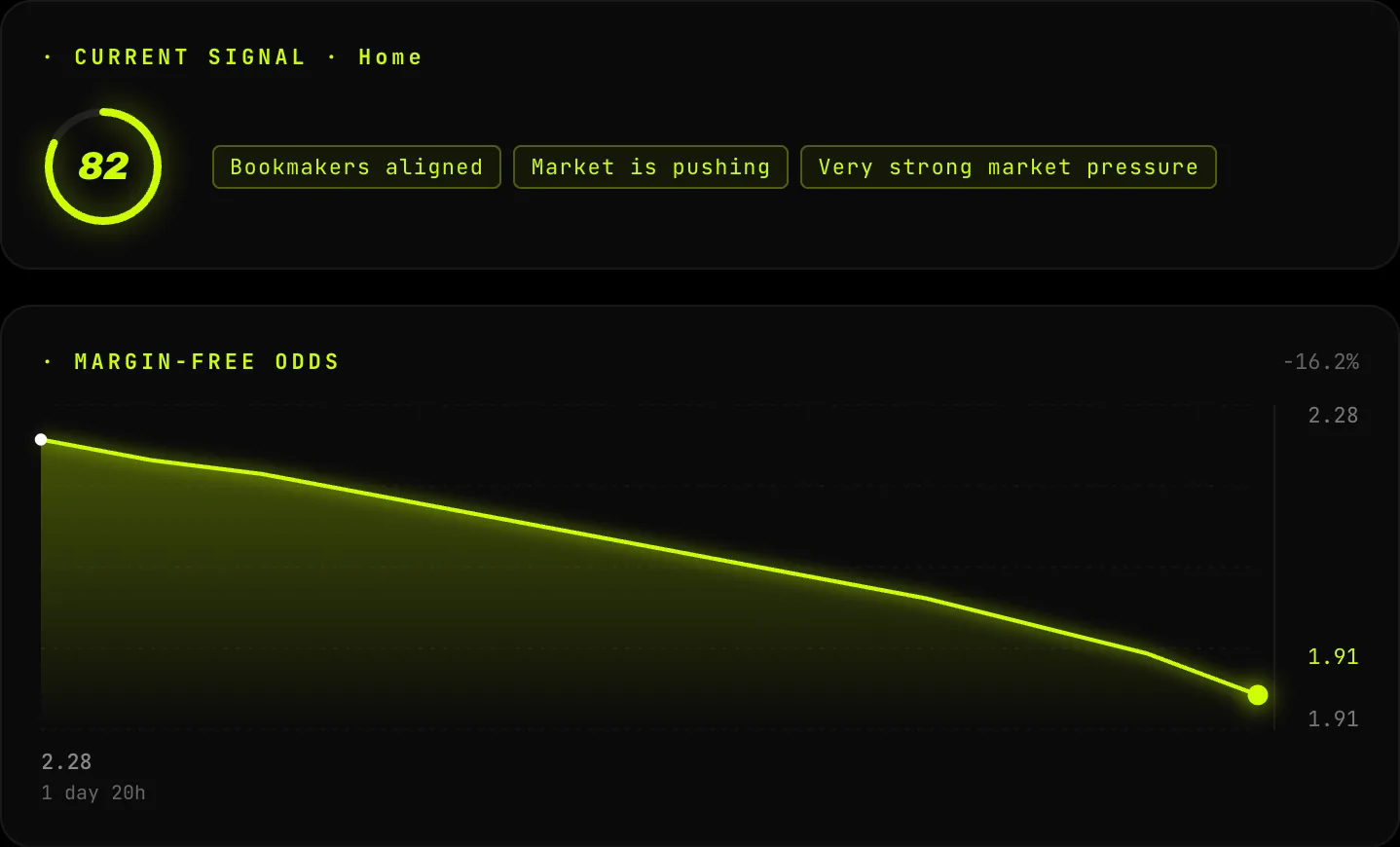
A football price that drops from 2.10 to 1.85 within minutes, close to kickoff, with several bookmakers making the same adjustment, is a strong signal. That combination usually gets noticed.
In tennis, a price that goes from 1.90 to 1.55 within minutes, just before the match starts, while several bookmakers follow, is also strong. The very late timing adds to it.
In basketball, a price that edges from 1.80 to 1.75 over several hours, with few bookmakers adjusting, is a weak signal. It moves, but only a little.
Large variation, strong agreement, interesting timing, fast movement, a consistent market overall. None of these guarantees a result, but together they justify a closer look.
Full guide: how to read odds movements →
What a signal never guarantees
A signal isn't a prediction. It doesn't announce a result and it guarantees nothing. It's also a different thing from a value bet: a signal describes how the market is moving, while a value bet is a price judged wrong against a probability estimate.
All it says is that a movement deserves more attention than average.
No single indicator makes a signal
A big movement on its own may not mean much. The same goes for agreement between bookmakers, or a fast shift. It's usually several pieces together that turn a movement into a real signal. An isolated one often tells you little, and once several notable features line up, the level of attention tends to go up.
The most common mistakes
Five mistakes come up again and again among people who follow the market:
- believing a signal predicts a result
- watching a single bookmaker
- ignoring context
- mixing up a movement and a signal
- analysing one indicator in isolation
How OddScore analyses signals
OddScore compares odds from several bookmakers, removes the margin and tracks how the prices change. It then calculates a signal from 0 to 100, which sums up the pressure of the market.
It gives no staking advice. The AI reading summarises what the market is saying before the match, and it isn't a bet to follow. The aim is to help you understand the market, not to predict it.
Put it into practice
Apply this guide to real odds.
See a market reading
A real match with its odds, movements and 0-100 signal.
Open the demoMargin calculator
Measure a bookmaker's margin on any market.
Calculate the marginDig into the market
Odds movements are only part of the story. Here are the next topics to read.
Understanding odds movements
How line movements work, and why so many market analysts keep an eye on them.
UnderstandWhy odds change
Injuries, betting volumes, bookmakers reacting to each other: the main reasons behind market movements.
ExploreHow to read an odds movement
Direction, size, timing. The basics for making sense of a market movement.
Read the guideHow bookmakers adjust their odds
Why several bookmakers can show different prices on the same event.
See the analysisWhen the market moves fast
A steam move is a quick price shift that spreads across several bookmakers.
DiscoverFrequently asked questions
What is a market signal?
A movement that shows enough notable features to justify a closer look. It describes what the market is doing. It doesn't tell you what will happen.
Is every movement a signal?
No. Most movements are routine adjustments.
Does a signal guarantee a result?
No. A signal tells you about the market, not about the score.
How do you spot an interesting signal?
Look at the size of the move, how fast it happened, when it appeared, how many bookmakers followed and whether the pieces point the same way.
Why are some signals stronger than others?
Because they pile up several notable features at once, instead of just one.
How does OddScore handle signals?
OddScore compares odds from several bookmakers, removes the margin and tracks how the prices change. From that it calculates a signal from 0 to 100.
Does OddScore give tips?
OddScore gives no staking advice. The AI reading sums up what the market is saying before the match. It isn't a bet to follow.
Sources & method
This page rests on observing odds movements, bookmakers and how the sports betting market evolves. It explains what a market signal is and how you can observe one, not how to predict a result. It also points to the UK regulator and a free helpline.
- Look at the size, speed, timing and consistency of each movement.
- Compare how several bookmakers behave on the same event.
- Tell a normal adjustment from a genuinely notable signal, without turning it into a tip.
- Angelini, G., De Angelis, L. & Singleton, C. (2020). Information, prices and efficiency in an online betting market. Finance Research Letters.
- Hegarty, T. & Whelan, K. (2026). Market structure and prices in online betting markets. Oxford Economic Papers, 78(1), 90-113.
- Gambling Commission, public and players.
- BeGambleAware, free help and support.