
OddScore follows odds across several bookmakers before a match: direction of the move, intensity, timing, agreement between books. It strips out the margin to get probabilities, then sums them up as a signal from 0 to 100 and an AI reading. The method is the same in football, tennis, basketball, American football, baseball and ice hockey; only the markets tracked change. None of this is a bet to copy or staking advice. It's a way to see what the market is saying.
Football, tennis, basketball, American football: same method, different markets
| Sport | Markets covered | Outcomes | Competitions tracked |
|---|---|---|---|
| Football | Winner (1X2) + over/under goals (several lines, including 2.5) | 3 (win, draw, loss) | Premier League, La Liga, Serie A, Bundesliga, Ligue 1, Primeira Liga, MLS, Champions League, Europa League, Conference League, UEFA Nations League |
| Tennis | Match winner | 2 (no draw) | Grand Slam, Masters 1000, ATP 500, WTA 1000/500 (men's and women's singles) |
| Basketball | Winner + spread + over/under points | 2 (no draw) | NBA, EuroLeague |
| American football | Winner + spread + over/under points | 2 | NFL, NCAAF |
| Baseball | Winner + run line + over/under runs | 2 (no draw) | MLB |
| Ice hockey | Winner (overtime and shootout included) + puck line + over/under goals | 2 (no draw) | NHL |
The market-by-market detail is on the dedicated pages:
- Football odds analysis: 1X2 and over/under goals.
- Tennis odds analysis: match winner only.
- Basketball odds analysis: winner, spread and over/under points.
- American football odds analysis: winner, spread and over/under points.
- Ice hockey odds analysis: winner, puck line and over/under goals.
- Baseball odds analysis: moneyline, run line and over/under runs.
What OddScore analyses on a match
OddScore looks at odds movements on the main markets for the sport, the probabilities they imply and the best odds available. The markets depend on the sport, as the table above shows.
One price on its own says very little. A movement compared across several bookmakers, over time, with its intensity and timing, starts to tell you something. That comparison is the work OddScore does for you, so you don't have to open ten sites.
Odds variations
OddScore follows how odds evolve before the match: shortening, drifting, standing still or jumping.
Shortening odds can mean an outcome is attracting the market. Drifting odds can mean the opposite. One variation isn't enough on its own, and the context around it matters just as much.
Comparison between bookmakers
Bookmakers don't all react at the same moment.
OddScore compares odds variations across several bookmakers to spot shared movements, gaps and shifts in implied probability. That stops you mistaking a local adjustment at one book for a strong signal.
Timing of the movement
A move that appeared several days before a match doesn't read like a last-minute one.
Timing shows whether the market is moving slowly, quickly or all at once.
Intensity of the movement
A small variation doesn't weigh like a sharp, fast or repeated change across several bookmakers. OddScore measures that strength.
Market consistency
OddScore checks whether the signals point the same way or contradict each other. When direction, timing, intensity and bookmakers tell the same story, the market is much easier to read.
From odds to real probabilities
Raw odds contain the bookmaker's margin. OddScore removes it and ends up with probabilities, which are easier to compare from one market to the next.
You can then see more quickly whether a team (or a player) is gaining ground in the market, whether a scenario is gaining weight or losing support.
How the OddScore signal is built
OddScore turns odds movements into a market signal, then puts them in context with an AI reading before the match.
The signal shows where the movements are most readable. The AI reading then draws on the probabilities, the bookmaker data and the pre-match info to describe the match dynamics. It doesn't try to predict a result.
Step 1: Collect the odds
OddScore tracks the odds available before the matches it analyses and notes how they change over time: odds shortening, drifting, quiet markets or fast moves.
Step 2: Compare bookmakers
The variations are laid side by side across several bookmakers. That shows up isolated moves, big gaps and the moments when several books head the same way.
Step 3: Analyse the movement
OddScore looks at several things together:
- the direction of the move;
- its intensity;
- its timing;
- how far bookmakers agree.
Step 4: Display a readable signal
The analysis is boiled down to a signal from 0 to 100. You can spot the markets that are really moving at a glance, without spending your evening comparing odds book by book.
How to read the OddScore score from 0 to 100
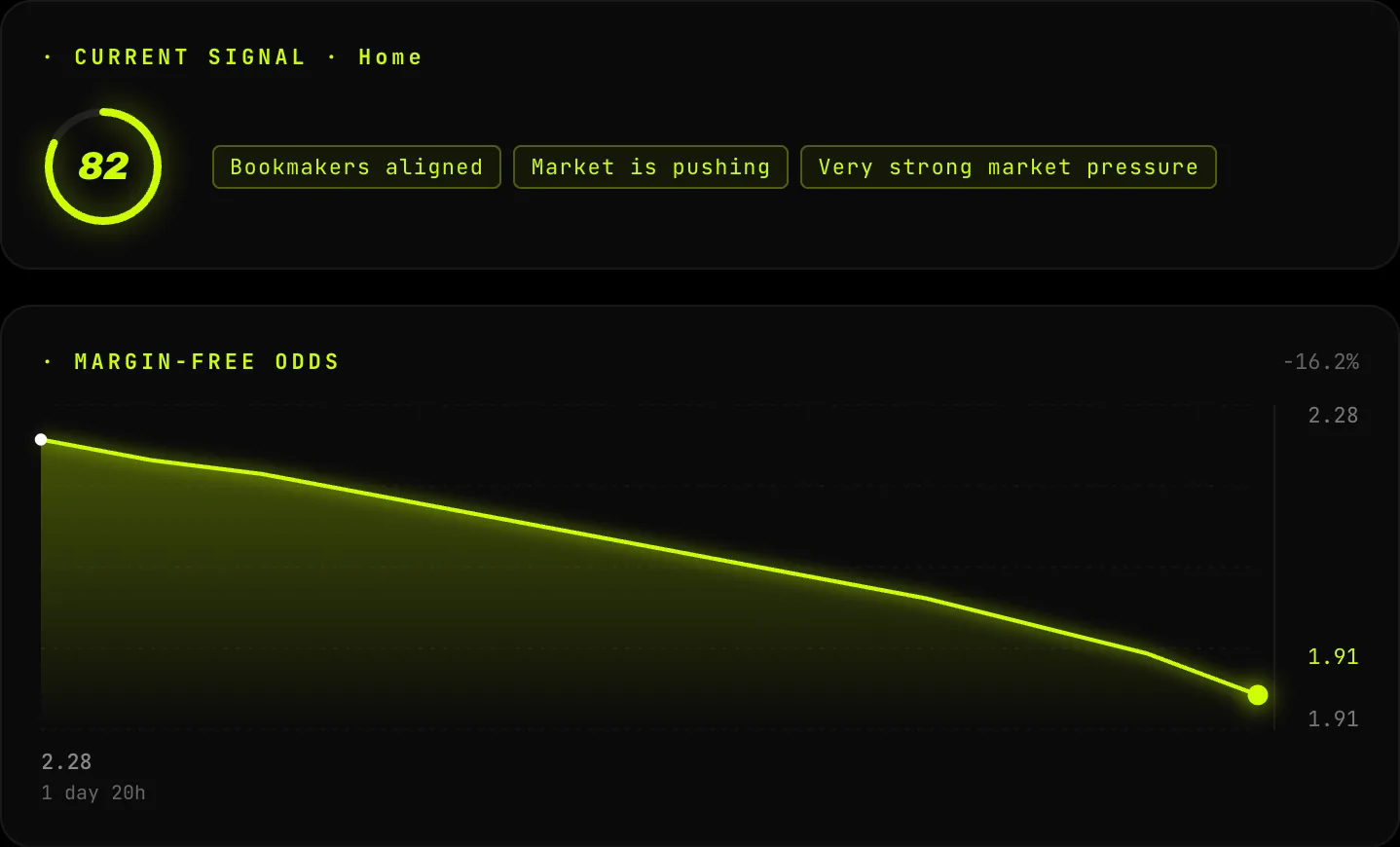
The score shows the market's pressure on an outcome. It isn't a win probability. It's an indicator of how the odds are moving, in which direction and how strongly. I'd rather you read that number as pressure than as probability, because the two are easy to mix up.
The higher it is, the more the market is pushing that way. The lower it is, the more the market is moving away from it.
| Score | What it means |
|---|---|
| 80-100 | The market is pushing very hard this way. The movements detected are big and largely aligned. |
| 60-80 | Movements are becoming visible. The market is sending consistent signals, but the pressure is still moderate. |
| 40-60 | A few movements, nothing very marked. The market stays fairly neutral and holds its positions. |
| 20-40 | A few movements against this outcome. The odds are starting to drift and the market is getting more cautious. |
| 0-20 | The market is clearly heading the other way. The signals mostly go against this outcome. |
The score doesn't tell you what to bet. It shows whether the market is pushing, hesitating or opposing an outcome, in football as much as in tennis or basketball.
Why a signal rises or falls
A signal can change before the match starts. The market moves, bookmakers adjust their prices and new info comes in.
The signal can rise when
- odds shorten;
- several bookmakers line up;
- fast movements appear;
- the market pushes in a clear direction.
The signal can fall when
- odds drift back out;
- the market calms down;
- bookmakers change direction;
- the original move loses intensity.
A rising signal doesn't mean "bet won", and a falling one doesn't mean "bet lost". It only says the market is changing.
The role of AI analysis
AI analysis sums up odds movements, probabilities and pre-match info in a clear reading of the market.
It describes the dynamics before kickoff by linking the signals it sees to the data available on the match. It doesn't predict the result.
In practice, it sorts out what's moving, in which direction, how strongly, when, at which bookmakers and how consistently.
What the AI does not do
It guarantees no bet and recommends no stake. The reading does show a verdict (a winner, a spread, a total), but that's a summary of what the market is saying. It isn't a bet to follow. It simply helps you understand a market that can be hard to read, whatever the sport.
OddScore is not a typical tipster site
OddScore doesn't hand you a slip to follow blindly. The app offers a reading of the market: odds movements, probabilities, bookmaker signals and an AI analysis before the match. The decision stays yours, with more context than a hunch or a single price.
A tip gives a firm opinion on how a match will end. OddScore starts from bookmaker odds, market movements and the signals visible before the event, and shows you what they say.
OddScore is not a bookmaker
OddScore doesn't take any bets and doesn't hold any user funds. The app compares and analyses odds published by licensed bookmakers. It never sets, offers or settles a bet itself.
A concrete market reading example
Picture a favourite going from 2.10 to 1.85 at several bookmakers within a few hours. At first glance, you'd say the market is pushing on the favourite.
To me, that's the trap of this kind of screen: a clear shortening seems to say everything, yet you don't know who moved first.
To interpret a shortening, OddScore also looks at:
- the size of the drop;
- how many bookmakers are involved;
- the timing of the move;
- how the other markets reacted;
- the overall consistency of the signal.
If several elements point the same way, the signal can get stronger. If the move is isolated or contradicted by other bookmakers, the reading stays cautious. A price that shortens is one piece of information. A move confirmed by several signals is already a real market reading.
Put it into practice
Apply this guide to real odds.
See a market reading
A real match with its odds, movements and 0-100 signal.
Open the demoMargin calculator
Measure a bookmaker's margin on any market.
Calculate the marginDig into the market
Odds movements are only part of the story. Here are the next topics to read.
Understanding odds movements
Why odds shorten or drift, and what those moves say about the market.
Read the guideWhy odds change
Injuries, betting volumes, bookmaker adjustments: what makes a price move.
UnderstandReading odds variations
Market, period, timeline, measure: the step-by-step method for describing a movement.
See the methodMarket signals
What strengthens a reading, what weakens it, and when it's better to hold off judging.
ExploreBookmaker analysis
Why bookmakers don't all show the same odds, and why their moves differ.
See the analysisFrequently asked questions
Does OddScore give betting tips?
Not in the tipster-site sense. The AI reading sums up what the market is saying and shows a verdict (a winner, a spread, a total), but it isn't a bet to follow. OddScore guarantees nothing, doesn't predict exact scores and gives no staking advice.
How does OddScore calculate its signals?
It compares odds from several bookmakers over time: direction of the move, intensity, timing and agreement between books. That analysis is then boiled down to a signal from 0 to 100.
Does the OddScore score predict a match result?
No. It measures what the market is doing on an outcome, not what will happen on the pitch. An 85 means the odds are pushing hard one way, not that the outcome will happen.
Why compare several bookmakers?
Because they don't all react at the same moment. When several books move the same way, the move is sturdier than one bookmaker adjusting its own price.
Does OddScore use AI to analyse matches?
Yes. The AI sums up odds movements, probabilities and pre-match info in a reading before kickoff. It describes the market. It doesn't guarantee a result.
Which sports does OddScore cover?
Football, tennis, basketball (NBA, EuroLeague) American football (NFL, NCAAF), baseball (MLB) and ice hockey (NHL). The markets tracked depend on the sport; the table on this page has the detail.
What does a high score mean?
That the market is pushing hard and consistently in one direction. It doesn't mean the outcome will happen.
Why can a signal drop?
Because odds drift back out, the market calms down, bookmakers change direction or the original move runs out of steam.
Does OddScore analyse every match?
No. OddScore focuses on matches whose markets are readable enough to analyse properly. Better a few matches read well than noise everywhere.
What's the difference between odds and a probability?
Raw odds contain the bookmaker's margin. OddScore strips it out to get a probability, so you can compare the scenarios of a match on a fairer basis.
Sources & methodology
This page describes OddScore's method: reading odds movements, margin-free probabilities, comparison between bookmakers, timing of adjustments, then an AI reading. It doesn't claim to predict results. For the regulatory framework and player support, the official links are below, along with an academic reference on how prices form in online betting.
- Watch odds variations across several bookmakers.
- Convert odds into probabilities to remove the bookmaker's margin.
- Compare the direction, intensity and timing of the moves.
- Check whether the bookmakers are moving the same way.
- Boil it down to a signal from 0 to 100, backed by an AI reading.