


A market signal isn't a prediction. A movement carries more weight when several sportsbooks follow it, when it survives the margin being stripped out, when it lasts and when it's large for its market. It carries less if it's isolated, reversed or just a margin change. If none of that is clear, don't conclude.
Not every movement is a signal
Thousands of odds move every day, for all sorts of reasons. Nearly all of it is routine adjustment. A market signal is a movement that still looks notable once you've checked what else could explain it.
This page starts from a movement you've already described: the market, the period, the timeline, how the sportsbooks compare. That step lives in how to read an odds movement. The question here is a different one. What is this movement worth?
Every signal is a movement. The reverse isn't true, which is why sorting them is worth the effort.
Describe a movement step by step →
What a movement actually shows you
A change in price tells you one thing: one or more sportsbooks changed their number. From there you can see:
- which way the price moved, by how much and when;
- which operators moved, and in what order;
- the gap that's left between them.
It doesn't tell you why the price moved, who bet or how much. Everything else is a hypothesis, and it should be presented as one. A signal isn't a value bet either: a value bet compares a price with a probability estimate, while a signal describes how the market behaves.
What makes a movement stronger
When several checks point the same way, the movement gains weight.
- Several sportsbooks move in the same direction on the same market. When it spreads fast, that's a steam move.
- The margin-free odds move too. The sportsbook has revised its view and hasn't just touched its margin.
- The price doesn't drift back within the hour, and the move is still there in the closing line.
- The change is large for its market. Three points of probability on a major competition, where prices barely move, count for more than on a minor fixture where they jump around all the time.
- A public, checkable piece of news explains it, such as an official team sheet. The movement becomes readable, without announcing a result.
What weakens it
Other things should lower your confidence.
- Only one sportsbook moves. It may be managing its own risk, fixing a mistake or catching up late. The sportsbook analysis explains why operators disagree.
- The price is simply rejoining the market. A sportsbook that was out on its own and drifts back to the consensus is closing a gap and adds no new information.
- Every outcome shortens at once. If both teams' prices drop together, it's usually the sportsbook's margin changing rather than its view of the match.
- A drop followed by a return to the starting price weighs less than one that holds.
- A few hundredths of movement are part of normal life on some markets.
The data you don't have
Even well described, a movement is incomplete information. You're almost always missing:
- the stakes, because sportsbooks don't publish their volumes and the price doesn't let you work them out;
- who placed the bets, so there's no telling whether the move follows a few big bets, lots of small ones or none at all;
- the cause, since news known to a few people before it goes public stays invisible;
- the real opening price, when the first snapshot comes after the market opened;
- what happened between two timestamps, which can hide a round trip.
These gaps don't make the analysis useless. They set its limit.
When not to conclude
Sometimes the honest answer is "I don't know yet". That's the case when:
- only one operator has moved and the others haven't been checked yet;
- sportsbooks are heading in opposite directions;
- the timeline has holes around the key moment;
- the prices you're comparing aren't on the same market, the same line or the same rules;
- the movement has only just started.
In those cases, just note "movement seen, weight unknown".
Four examples, and their limits
These examples are made up, for teaching.
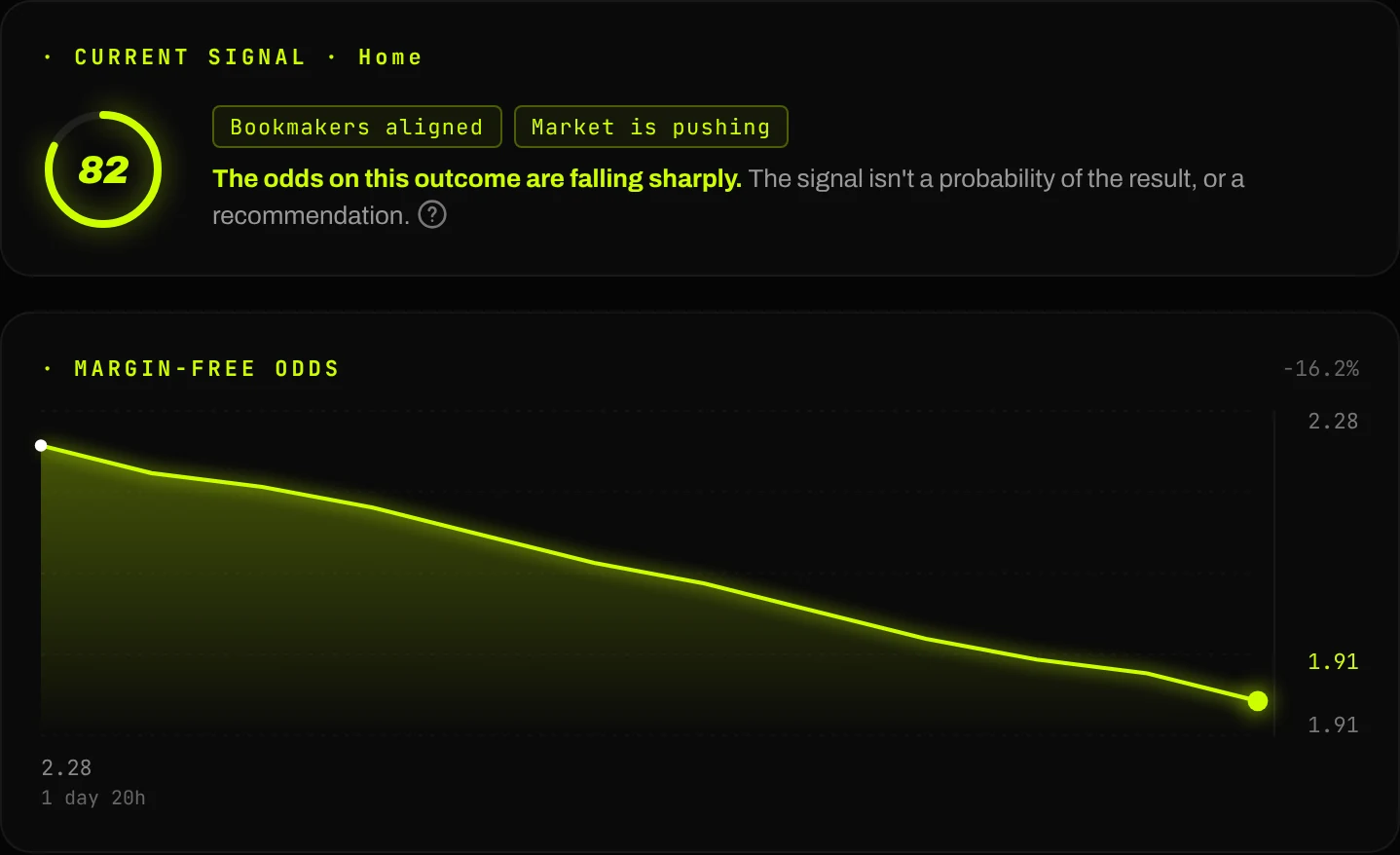
The movement is shared, it holds until kickoff and the margin-free price drops too. Limit: you don't know its cause or the stakes, and it doesn't say who'll win.
One operator on its own, a move that's almost undone: the simplest reading is an internal adjustment. Limit: if the other sportsbooks weren't checked at the same moment, they may have moved too.
Both prices shorten together. The sportsbook's margin is going up, and each player's margin-free probability stays where it was. Limit: check it on the margin-free odds, not by eye.
The market disagrees with itself. Limit: no reading wins out, so you wait or hold off on any conclusion.
I've got a soft spot for that last case. Writing "no conclusion" in a guide feels odd, yet it's often the most accurate answer.
What a signal never guarantees
A signal doesn't announce a result and guarantees nothing. It tells you a movement deserves a closer look than average.
On its own it says nothing about expected value. It describes the market and stops there. Spotting a signal and predicting a score are two unrelated exercises.
The mistakes we see most
- believing a signal predicts a result;
- drawing a conclusion from one sportsbook;
- mistaking a margin change for a change of mind;
- inferring the stakes from a price change;
- forgetting that a movement can be reversed.
How OddScore helps you weigh a movement
OddScore tracks the odds of several sportsbooks, removes the margin and scores each movement from 0 to 100. The signal already covers part of the checks in this guide: the direction and size of the move without the margin, its timing, and how far sportsbooks agree.
When a price drops sharply, OddScore also looks for what may have caused the drop, an injury or an absence for instance, and shows it as a lead. In this guide's terms, it's still a hypothesis: sometimes nothing explains the move, and the page says so. On the clearest drops, an OddScore Analysis goes through the move alongside the news on the game.
OddScore has no access to the amounts staked with sportsbooks. It gives no staking advice, and the market reading sums up what the odds say without being a bet to follow.
Put odds movements on your site →
Responsible gambling: a market signal isn't a bet to follow. Sports betting carries a risk of financial loss. Set yourself a budget, don't chase your losses, and use the deposit limits and self-exclusion tools available. Need to talk to someone? The National Council on Problem Gambling helpline is 1-800-MY-RESET (1-800-697-3738). Learn more about responsible gambling.
Put it into practice
Apply this guide to real odds.
Dig into the market
Odds movements are only part of the story. Here are the next topics to read.
Understanding odds movements
How line movements work, and why so many market analysts keep an eye on them.
UnderstandWhy odds change
Injuries, betting volumes, sportsbooks reacting to each other: the main reasons behind market movements.
ExploreHow to read an odds movement
Direction, size, timing. The basics for making sense of a market movement.
Read the guideHow sportsbooks adjust their odds
Why several sportsbooks can show different prices on the same event.
See the analysisWhen the market moves fast
A steam move is a quick price shift that spreads across several sportsbooks.
DiscoverFrequently asked questions
What is a market signal?
An odds movement whose weight holds up under scrutiny: followed by several sportsbooks, visible without the margin, lasting and large for its market. It tells you about the market. It predicts nothing.
Is every movement a signal?
No. Most movements are routine adjustments with no particular weight.
What weakens a movement?
A single sportsbook moving, a quick return to the starting price, a simple margin change, or a shift that stays within the market's usual noise.
Can you work out the stakes from an odds movement?
No. A price can move without a big bet, and a big bet can leave the price unchanged. Sportsbooks don't publish the amounts staked.
Does a signal guarantee a result?
No. A signal describes the market. It doesn't announce the score.
How does OddScore help you weigh a movement?
It scores every movement from 0 to 100 using the odds of several sportsbooks, margin stripped out, and when a price drops sharply it looks for what may have moved it. It gives no staking advice, and the market reading sums up what the odds say without being a bet to follow.
Sources & method
This page explains how to judge the weight of an odds movement you've already described. The examples are made up for teaching: they show a line of reasoning, not real matches. Nothing here aims to predict a result. It also points to a regulator and a helpline for readers in the US.
- Start from a movement described on the same market, the same selection and the same period.
- List what strengthens and what weakens the reading, then the data that's missing.
- Keep the conclusion in proportion to what you know, without turning it into a tip.
- Angelini, G., De Angelis, L. & Singleton, C. (2020). Information, prices and efficiency in an online betting market. Finance Research Letters.
- Hegarty, T. & Whelan, K. (2026). Market structure and prices in online betting markets. Oxford Economic Papers, 78(1), 90-113.
- New Jersey Division of Gaming Enforcement, sports wagering.
- National Council on Problem Gambling, help and treatment.