
AI aggregates huge volumes of data, spots statistical regularities and compares dozens of markets non-stop. It doesn't remove sporting randomness, can't see context nobody has encoded, and guarantees no result. If you remember one thing, make it this: estimating a probability isn't the same as predicting a result.
Estimating a probability isn't predicting
AI helps you read and structure data. It doesn't turn a match into a certainty.
A model gives you a probability estimate. Saying "this outcome is at 62%" and saying "this outcome will happen" are two different claims. The first can be checked across a large number of matches. The second can never be checked on a single one. How a price becomes a probability is covered on the implied probability page.
This page is the way into the topic. Two questions branch off it and have their own pages: can AI predict a match? and the limits of AI predictions.
A "62%" also means the roughly four times in ten it goes the other way, assuming the model is well calibrated. The figure is precise, but it tells you nothing about what happens on the night.
What AI does well
Four things that no manual analysis matches at the same volume. It aggregates: whole seasons of results, dozens of competitions, thousands of lines of odds, with no fatigue and nothing forgotten. It spots regularities, including combinations of variables no one's intuition would have come up with. It compares several operators non-stop and sees price gaps as they appear. And it structures messy data into one consistent reading, comparable from one match to the next.
The review by Bunker and Susnjak adds something on that last point. Across the work they surveyed, how the variables are chosen and built matters more for the quality of the results than the sheer volume of data. More data isn't enough. The right data counts for more. I care more about that finding than about any claim of computing power, since it moves the question from volume to variable choice.
What a model can't see
A model only sees what's been encoded. Anything that hasn't become a variable stays invisible to it, however much it matters on the pitch.
| Limit | What it means in practice |
|---|---|
| Unencoded qualitative context | Internal tension, particular stakes, a recent change of coach: invisible |
| Last-minute information | A lineup announced late isn't in the training data |
| Sporting randomness | An injury mid-match, a refereeing decision: impossible to model by nature |
| Explaining the result | A model can be right without anyone knowing why |
More computing power fixes none of these limits. They come from the information available before a match.
Responsible gambling: an AI figure makes no bet risk-free. Sports betting carries a risk of financial loss. Set yourself a budget, don't chase your losses, and use the deposit limits and self-exclusion tools available. Learn more about responsible gambling.
What OddScore's AI does
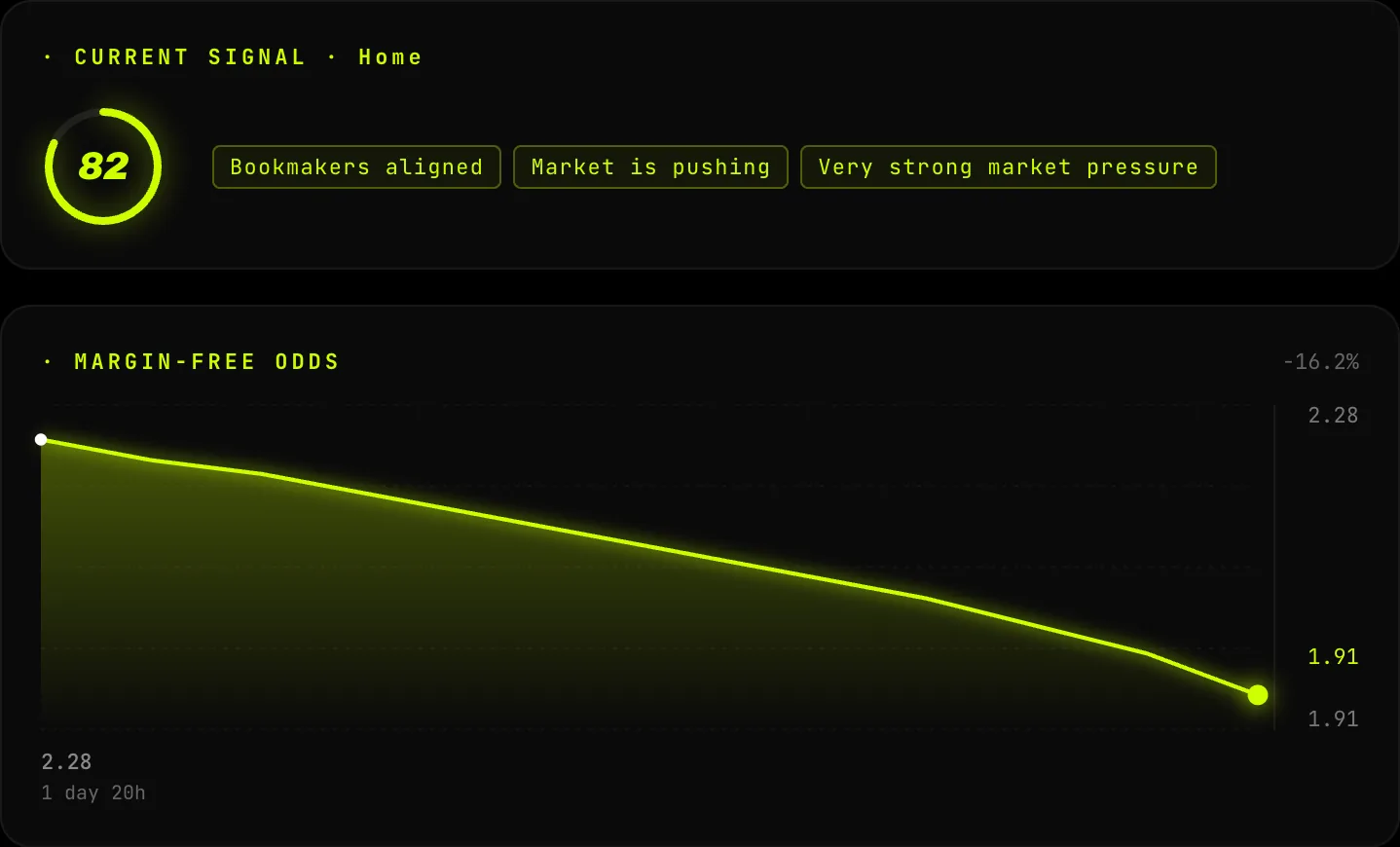
OddScore compares the odds of several bookmakers, removes the margin to get back to fair odds, and tracks how they move over time. From that comes a signal from 0 to 100, which sums up the direction and strength of the movement on the market. Before the match, the AI writes a reading from this data, with a verdict: a winner, a handicap or a total, depending on the sport.
That reading sums up what the market says at that moment and which way it has moved. What the market rates isn't what will happen. So the verdict isn't a bet to follow, and OddScore gives no staking advice.
Three questions to ask any "AI" betting tool
AI vocabulary often hides the lack of a method. Three questions are enough to sort the serious tools from the sales pitches:
- which data is the model trained on, and up to what date?
- what exactly does it output: a calibrated probability, or an outcome with no margin of error?
- can you inspect the reasoning, or do you only see the final figure?
A tool that names an outcome with no probability, no dated data and no explanation is just an opinion, with or without the word "AI".
What AI allows, and what it leaves open
Three levels to keep apart. AI lets you process volumes of data out of reach by hand, compare markets non-stop and produce a consistent reading from one match to the next. It lets you estimate a probability, with a margin of error that stays large. It never lets you conclude that an outcome is going to happen.
Why estimating isn't predicting →
The concrete limits of AI-generated predictions →
Back to the complete sports predictions guide →
Put it into practice
Apply this guide to real odds.
See a market reading
A real match with its odds, movements and 0-100 signal.
Open the demoMargin calculator
Measure a bookmaker's margin on any market.
Calculate the marginDig into the market
Odds movements are only part of the story. Here are the next topics to read.
Football prediction and artificial intelligence
xG, form data and models applied to football.
See the football applicationCan you predict a match with AI?
Why estimating a probability isn't predicting a result.
Understand the nuanceThe limits of AI predictions
Incomplete data, black boxes, too much trust in a precise figure.
See the limitsSports predictions: analyse before you bet
The complete guide: data, odds, reliability, bias and the role of AI.
Read the guideFrequently asked questions
Can AI predict a sports result with certainty?
No. No model removes the uncertainty of a match. It produces a probability estimate, which is a different thing from a prediction.
What does an AI model actually look at?
Structured, historical data: results, sport-specific performance indicators, the fixture list, and often the odds themselves. It only sees what's been encoded.
Does OddScore use AI?
Yes, for a reading of the market before the match. OddScore compares the odds of several bookmakers, removes the margin, tracks how they move and calculates a signal from 0 to 100. The AI then writes a reading with a verdict. It sums up what the market says.
Is an AI model more reliable than a human analyst?
At handling volume and staying consistent, yes. On qualitative context, like the mood in a dressing room or what's riding on a fixture, it sees nothing that hasn't been encoded.
Are the models getting better over time?
On data quality and how variables are built, yes. The review by Bunker and Susnjak (2022) also notes that the choice of variables matters more than the volume of data available.
Does OddScore give tips?
The AI reading shows a verdict, but it sums up what the market says. It's not a bet to follow, and OddScore gives no staking advice.
Sources & methodology
This page draws on an academic review of predicting team-sport results with machine learning, on a recent systematic review of machine learning in sports betting, and on public information from the UK Gambling Commission and BeGambleAware. The references were checked before publication.
- Separate what a model can process from what it can't see.
- Always keep estimating a probability apart from predicting a result.
- Describe the product's AI as it appears on screen.
- Label work that hasn't been peer-reviewed yet as preprints.
- Bunker, R. & Susnjak, T. (2022). The Application of Machine Learning Techniques for Predicting Match Results in Team Sport: A Review. Journal of Artificial Intelligence Research, 73, 1285-1322.
- Galekwa, R. M., Tshimula, J. M., Tajeuna, E. G. & Kyandoghere, K. (2024). A Systematic Review of Machine Learning in Sports Betting: Techniques, Challenges, and Future Directions. Preprint arXiv 2410.21484 (not peer-reviewed).
- UK Gambling Commission, Public and players
- BeGambleAware